
Advanced Film Financing
A live course with Phil Hunt and Stephen Follows, January 2027.
Funding gets your first film made.
Financing is how you make the next one.
Six live sessions for producers and financiers on films over $1m. What a lender will really lend against, what each piece of money costs you and how long it takes to arrive, and how the money finally comes back.
Funding or financing?
In the 20 years I've been doing this, the thing people ask me about most is money. How do I pay for my film? A lot has changed in that time (the films, the platforms, the whole business around them), but that question hasn't.
The way I see it, there are two quite different ways to pay for a film. The first I call funding. That's crowdfunding, donations, friends and family, or anyone willing to take a punt on you because they believe in the project, even when the numbers don't really add up. The second is financing, where the person putting money in has a realistic expectation of getting it back, and decides on the strength of the argument.
Both can be ethical, and both can get great films made, as long as you're clear about which one you're asking for and who you're asking. Your first film will probably be funded. But if you want to keep making films, at some point you have to move over to financing, which means returning money and building a track record.
This course is about that second kind of money, and the move from one to the other.
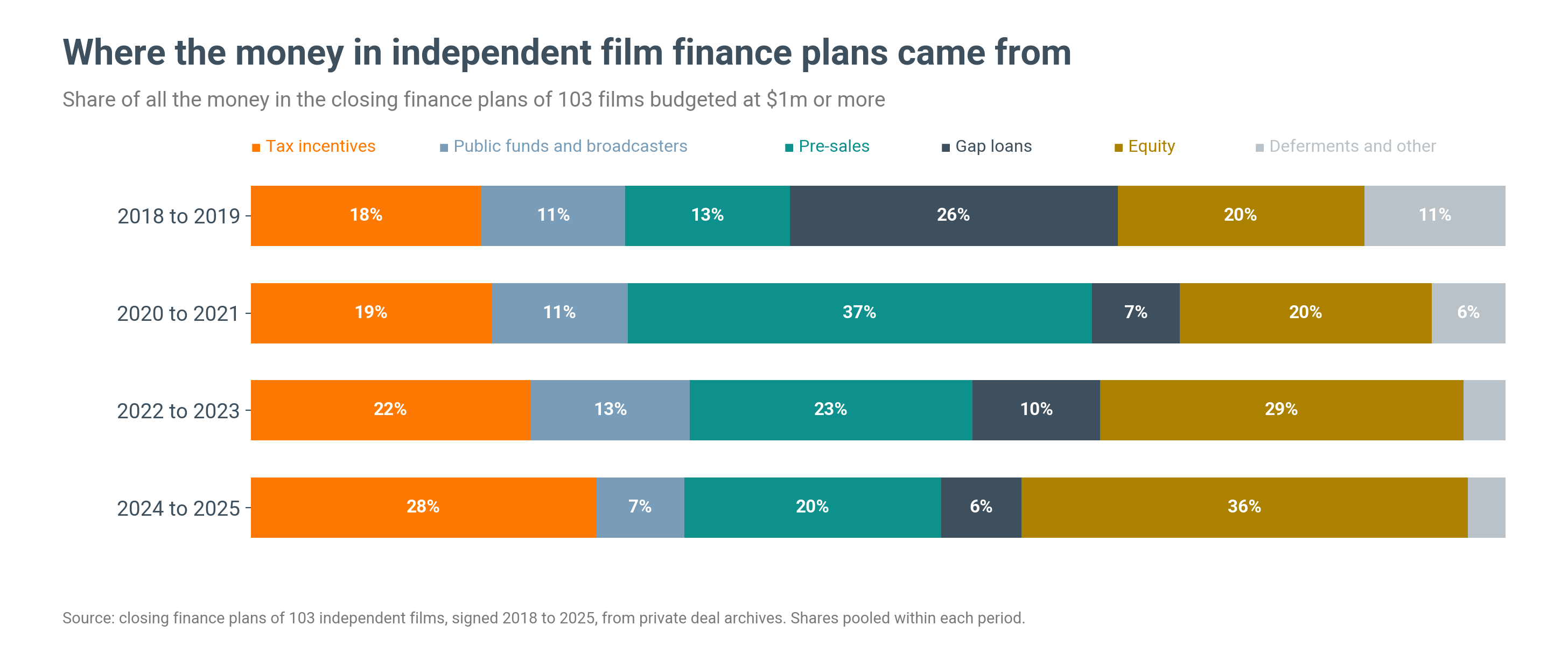
I've wanted to tackle it properly for a long time, but it's hard to do in articles, because each one looks at one topic and one set of data. So for well over a year I've been talking every week with Phil Hunt, who has spent nearly 25 years financing films and making money doing it. Phil has opened his files to me, and I've spent the past year talking to filmmakers about how they actually pay for their films, including a lot of them at TIFF this autumn.
I spend most of my working life in the data, and yet much of what I learnt from Phil and from those filmmakers I would never have found any other way. There's no equation for any of this. It's a practice, and the only way to understand it is to get your hands dirty and talk to the people doing it.
Now watch it happen to one film
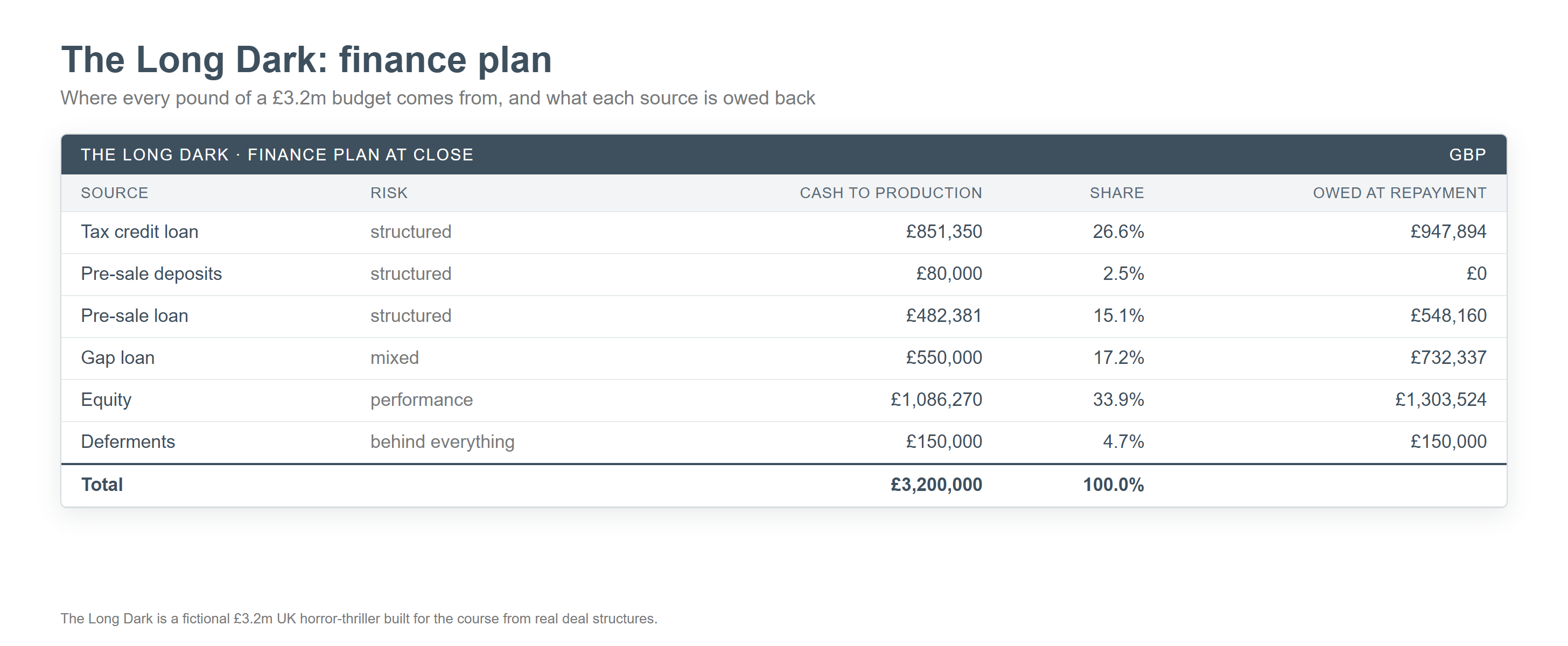
The course follows one film from its first finance plan to its last statement. The Long Dark is a £3.2m UK horror-thriller, and it doesn't exist. It's a teaching model, built to behave like a real film, and every problem it runs into has a real event behind it, drawn from private accounts of real deals. Because it's made up, I can open its books completely, numbers and all.
- On the producer's version of its finance plan, the gap loan looks comfortably covered. The agent's estimates for the unsold territories add up to about £1.5m, against a gap loan of £550,000.
- On the lender's version, the first thing that happens is what lenders call a 'haircut' (they knock a share off every estimate, in case it sells for less or doesn't sell at all), and those estimates get cut by 45%, to about £825,000.
That still sounds like enough, until you remember that the loan has to be repaid with its fees and interest, about £730,000 in all, and that every pound coming in pays the sales agent's commission and expenses, and the pre-sale lender, before the gap lender sees any of it. Run the numbers again, and the gap lender is about £170,000 short.
Both versions are honest, and both people know what they're doing. They're reading the same film from different chairs, and the gap between their two versions is what the financing conversation is about.
And that's before the money has to arrive
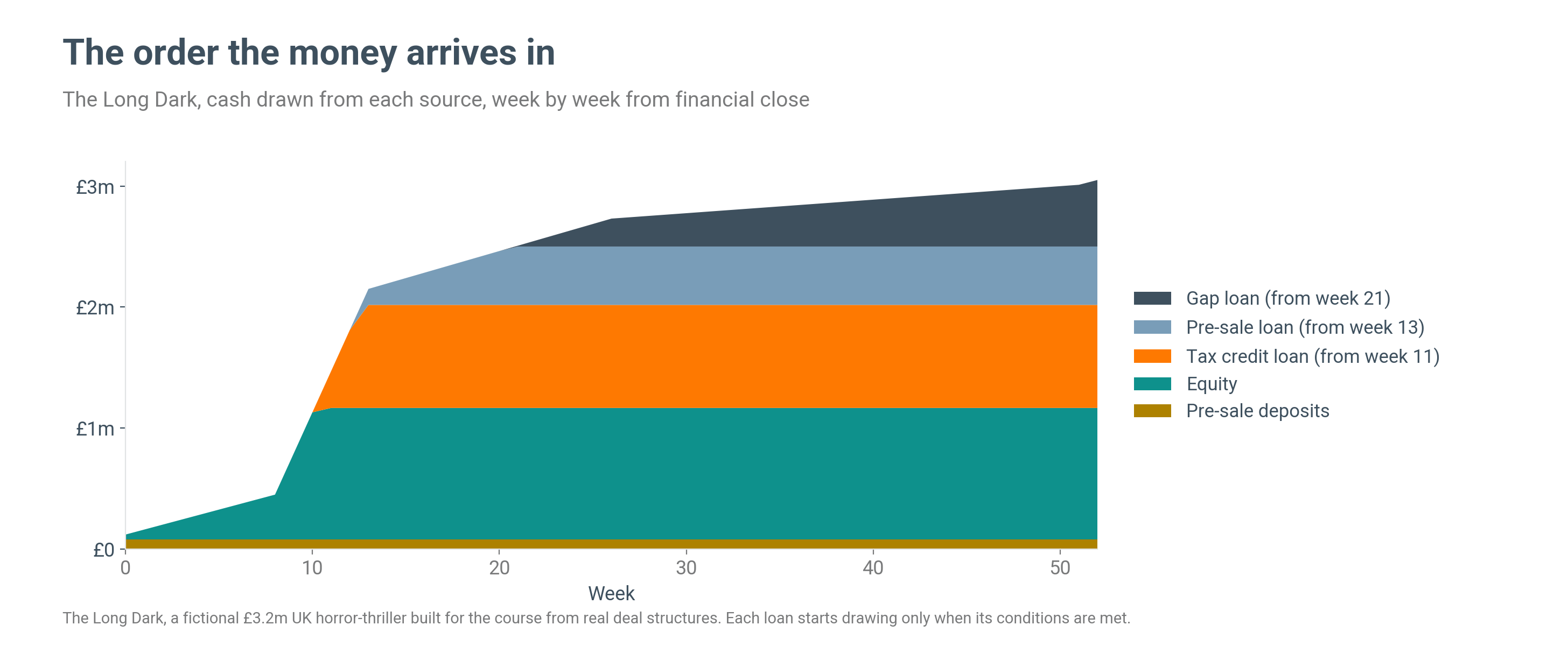
A finance plan is really a queue. Some money has to be confirmed before other money will move, and every wait costs interest that never shows up on the spreadsheet.
That's how a film ends up "almost there" for months, or closes its finance after the shoot has wrapped.
Money costs money, too, and what you pay to cash-flow a tax credit or borrow against a pre-sale is one of the numbers people least like to publish. Session 3 puts the main kinds of film money on one dated price list, including tax-credit cash-flow loans, so you can check a quote before you sign.
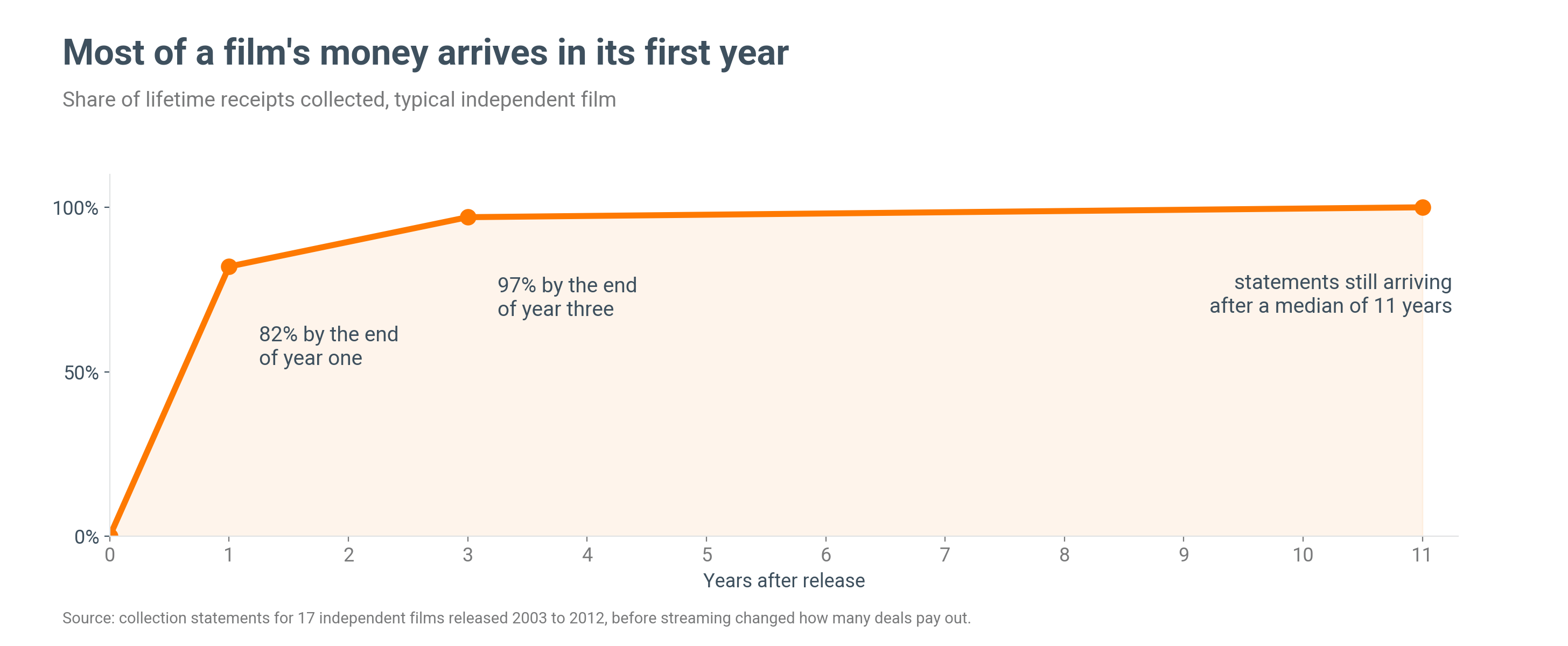
Then there's getting paid, and this is the one that surprised me. In the collection statements I've studied, the typical film had collected 82% of everything it would ever earn within a year of release, and 97% by the end of year three. And yet the statements kept arriving for a median of 11 years. So the first year's statements matter, and sadly they're also the hardest to check from the outside. (That's 17 films released between 2003 and 2012, so before streaming changed how a lot of deals pay out.)
None of this is new, exactly, but the business around these deals has become much riskier, as I wrote in June:
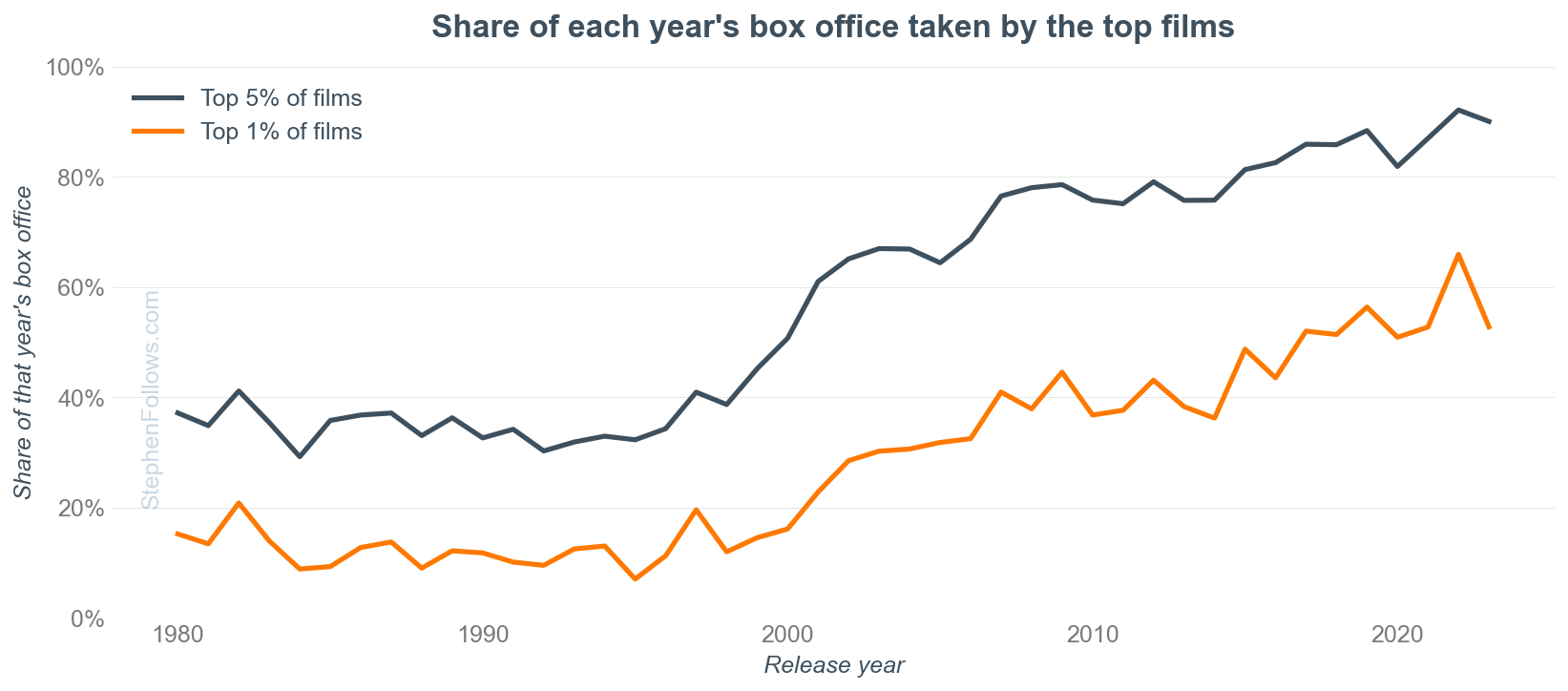
From my analysis of worldwide box office by release year, 1980-2023 (box office, not profit). Full article: How to make money in film when nobody can predict a hit (June 2026).
What can't you look up?
Search, and free writing (a fair amount of mine included!), will give you the definitions, along with rules of thumb that don't agree with each other.
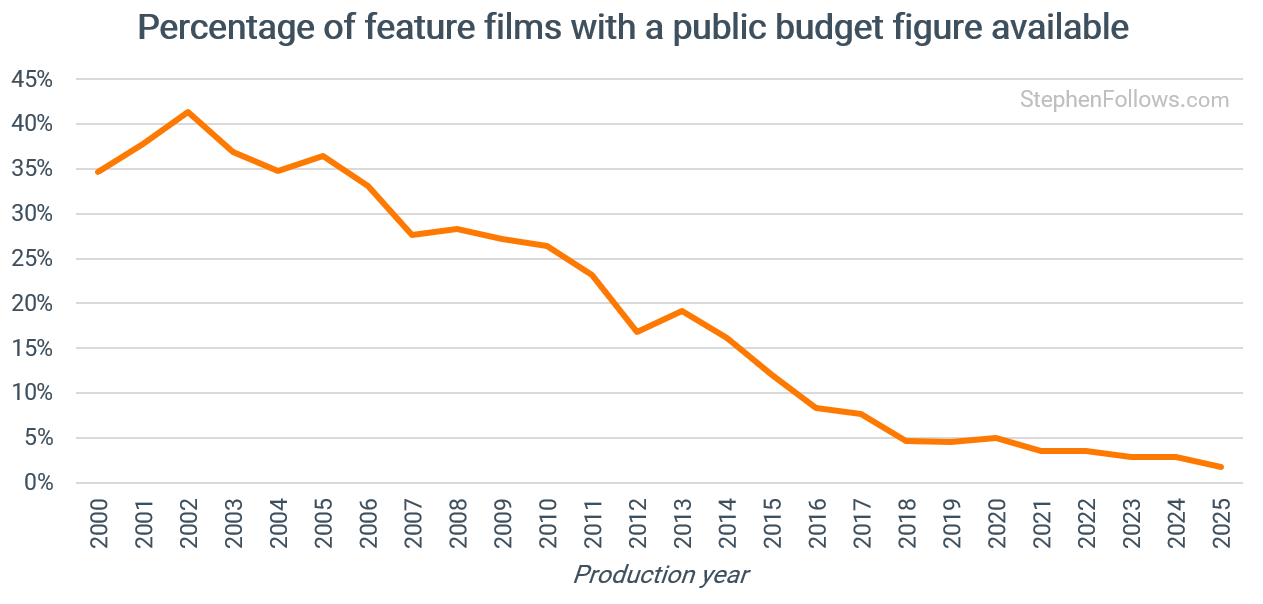
From my analysis of 62,298 feature films released commercially since 2000, by year of production. Full article: No-one knows how much movies cost to make anymore (November 2025).
Your lawyer, sales agent and financier each know their side of a deal thoroughly, and you'll still need them. But the people who know this business best tend to hit the same limit. Either they can't talk about it, because confidentiality comes with the job, or they've only seen their own side of the numbers.
Ask how much a lender will advance against a sales estimate, and you'll hear half the estimate for the unsold territories, a 50-70% haircut, or a quarter of the worst case. All three lean on where deals actually close, and none of them tells you.
So I looked at Phil's deal files as a whole. Across more than 1,100 territory prices from 45 films' sales estimates, the agent's asking price was typically double the 'take' (the price the agent expects to accept). And of the 41 deals I could match to a take set beforehand, the typical one closed right at it, at 1.00 times. In other words, the asking price is an opening bid. (It only covers territories that sold, though, and in an estimate the bigger risk is the territory nobody buys at all.)
The course is built on evidence like that, including:
- Where deals actually land against an estimate, and what becomes of the territories nobody buys.
- What each piece of money should cost you, how long it takes to arrive, and how to spot an offer that's fair on paper but quietly expensive.
- What anonymised real statements show came back to investors and lenders.
What will you be able to do?
The course won't find you money (nothing honest could promise that).
But think about your next financing conversation. Most producers find out what their estimates are worth when a lender cuts them, and what the money costs when the quote lands. This course gets those sums done before you walk in, and you can do them again on every deal after that. In practice:
- You can answer the hard questions an investor or lender will ask (how and when they get their money back, what happens if the budget isn't fully raised), and show your working.
- Before you sign, you can check what a gap loan or a tax-credit cash-flow loan should cost against a dated range.
- You know which parts of your plan a lender will lend against, and which depend on an audience turning up.
- When the first statements arrive, you know what to check, and what to ask your lawyer.
And if you finance, sell or advise on these films, you get to see the whole of a deal you usually only see part of.
6
live sessions on Zoom
90
minutes each, with live Q&A
1
film, from its first finance plan to its last statement
12
months to refer back to the recordings
How the sessions work
The course includes six live Zoom sessions with Phil Hunt, from 12 to 28 January 2027. Each one takes a stage of the deal, following The Long Dark all the way through.
Each session has three parts. I teach with the data, then Phil and I talk through what happens in practice, and then comes a practical.
In most sessions, Phil works through realistic deal material and says what he'd do, and you have a go yourself, either before him or straight after. I set the deals up, and Phil knocks them down.
Session 1 starts from your own project, so do bring the one you're working on.
When I asked students on my 2022 courses how they could be better, one suggested a fictional case study. So this is one, run end to end.
"Don't I know most of this already?"
If you've closed films, you already know how a deal works, and doing deals does teach you. But it teaches you one deal at a time, over years, and mostly from your own chair. What's hard to see from there is what everyone else in the chain is charging you, and how that has changed since your last deal. The course puts every seat's numbers in front of you, dated, on one film.
The details
- What: Advanced Film Financing, six live sessions on Zoom, taught by me with film financier Phil Hunt.
- When: Tuesdays and Thursdays, 12, 14, 19, 21, 26 and 28 January 2027, at 4pm UK (11am New York, 8am Los Angeles).
- How long: 90 minutes each, with 60 minutes of teaching and 30 of live Q&A.
- Questions: every session has time set aside for yours.
- Before you start: some sessions come with a short pack to read or fill in.
What will you learn, session by session?
Judge the level for yourself from the detail below.
Session 1 · Tue 12 Jan · Where does a film's money come from, and who gets paid first?
You leave with your own project mapped on one page.
- Sort every dollar in a plan by what it rests on, a signed contract or an audience turning up.
- Why picking your place in the repayment order is often a bigger call than picking the film.
- The usual ways a pitch deck flatters its box office, comparables and estimates, and how to spot them in yours.
Practical: your own project on a single page, with every source of money and who gets repaid in what order. Anything you can't fill in becomes a question for the right person, while it's still cheap to ask.
Session 2 · Thu 14 Jan · What's the film worth, and who's selling it?
You leave with your own floor under the film's value.
- Setting your minimum value for the film before the agent's estimate is on the table.
- Which of an estimate's two price columns a lender treats as real, and which as an opening bid.
- Choosing a sales agent on evidence, holding them to account, and agreeing up front how you'd part ways.
Practical: a fictional sales estimate with problems planted in it. Phil marks it up, and then you read a second one yourself.
Session 3 · Tue 19 Jan · Which lenders will back it, and what do they charge?
You leave able to price a loan quote against a dated list.
- The main kinds of film money on one dated price list.
- How much usable cash you actually get on day one from a signed pre-sale and a tax credit.
- What happens to your plan inside a lender, and the headings a working lender scores each file under (adapted from Phil's own checklist).
- Spotting an offer that's friendly on paper but quietly expensive, and working out its real cost.
Practical: the full finance plan for The Long Dark. You price each layer first, and then Phil prices it, out loud.
Session 4 · Thu 21 Jan · How does the deal close, and who controls the cash?
You leave knowing the order everything has to happen in, and what each delay costs.
- The order in which each source of money has to be confirmed, and how closing day runs.
- How cash is released in stages against conditions, and which deadlines make a delay expensive.
- The handful of ways a financed film typically fails, and where in the paperwork each one is dealt with.
Practical: The Long Dark hits three separate crises, from before the shoot to after delivery. You say what you'd do first, and Phil explains how it would play out.
Session 5 · Tue 26 Jan · How does the money get back to everyone?
You leave able to read a collection statement and check it.
- Every line of the waterfall (the order everyone gets repaid in), and what a film must earn before anyone sees a profit.
- What anonymised real statements show came back to investors and lenders, and why year one matters most.
- What to do when money arrives late, short or not at all, and the check to run before you hire a lawyer.
Practical: a fictional collection statement for The Long Dark, with errors planted in it. Phil reads it, and each of you checks it from one seat in the waterfall.
Session 6 · Thu 28 Jan · How do you earn from film across a career, not just one deal?
You leave with a pre-flight checklist you can run on your next package.
- The few ways people earn from film, and choosing yours before choosing projects.
- Why a slate behaves so differently from a single film, and the maths of surviving the misses.
- Running a production company so it survives between films.
- A working financier's rules of thumb, and where each one stops holding.
Practical: a pre-flight checklist built on the headings a lender uses, run on The Long Dark and on a deliberately broken package. Then the floor is open.
Who's teaching it?

I'm Stephen Follows, a film data researcher. I've spent 20 years working in and studying the film business, and I publish what I find at StephenFollows.com, which has nearly 15,000 subscribers. My research has been covered more than 2,000 times by over 1,100 outlets in 36 languages, and it always states its samples, so you can see what was counted and how. Why your film can't secure distribution, built from 300+ film market professionals, is a good example.

Phil Hunt co-founded Head Gear Films in 2002 and has executive produced more than 300 feature films. Few people have financed more independent films. Head Gear has financed more than 550 films and series. Phil lends against films like yours, which puts him on the other side of the table, and on this course you see how a lender prices a deal from his side.
What people in the business say about my research
"I enjoy reading Stephen's analysis of the film business for its unique and useful insight into our industry and would happily recommend his writing to all filmmakers and film professionals."
Eric Fellner, Co-chair, Working Title Films
"Stephen's research is brilliant. No-one is doing data-driven analysis of the film industry quite like Stephen Follows. It is always very popular with our audience of producers and distributors."
Jonathan Wolf, Head of the American Film Market
"…At TIFF, I've found his insights illuminating, and I can imagine how much he has to offer to filmmakers."
Cameron Bailey, CEO, Toronto International Film Festival
"One of the industry's leading data scientists."
Chris O'Falt, IndieWire
"The man who crunches the film data like nobody else in the world."
Alex Ferrari, host of Indie Film Hustle
"I see him as one of the leading lights of our industry's transparency revolution."
Ted Hope, producer and former head of film production at Amazon Studios
Can I see it working before I pay?
The fairest test is to watch it happen. Phil and I are running a free webinar, What you can't look up about film finance, on Tuesday 8 December at 4pm UK (11am New York, 8am Los Angeles), where Phil works through a realistic, fictional finance package. Everyone who registers gets the recording.
I've also done this before, with two earlier courses in 2022. Between them, 46 places were paid for with no refunds, and in the end-of-course student survey, they rated their likelihood of recommending it at 4.85 out of 5.
Is it for you?
It's for:
- Producers and production-company principals developing, packaging or financing films over $1m.
- Producers stepping up to their first serious film at that level, making the move from funding to financing.
- Financiers, sales agents and others who work on those deals and want to see the whole of one.
It isn't for:
- Films under $1m. Those are usually funded rather than financed, and the money comes from different places, so Foundations: Fund Your Film is built for them. Just leave your email here and I'll tell you when it opens.
- Anyone hoping for introductions to investors or access to money. The course won't make introductions or find you money. It shows you how the deals work, so the conversations you have go better.
- Anyone after a general introduction to the film industry. My free newsletter is a better place to start.
What's included?
- Six live sessions, each recorded, with the recordings kept for the class to refer back to for 12 months.
- The workbooks and templates from the practicals, with the reasoning behind them.
- The Long Dark, opened up, with its documents filled in.
- Foundations: Fund Your Film, our recorded companion course, as reference. It opens to you by the end of November.
- The recording of our free webinar, in your library.
- An informal, private get-together with Phil and me in Berlin during the European Film Market, on Friday 12 February 2027. (Travel isn't included.)
What does it cost, and how do I join?
US$1,000. Prices include any VAT due.
Some live finance courses cost less. This one has a working financier going through realistic deal material in most sessions, teaching built on anonymised deal paper from real films, and one film worked from start to finish.
The dates are fixed, and the course runs on them no matter how many people join. If you change your mind within 14 days of buying, or before you've started, you get a full refund.
Enrolment closes at 23:59 UK (6:59pm New York) on Friday 8 January 2027. The first session is on Tuesday 12 January. When you join, you'll get a welcome email straight away, with the dates and what happens next.
The small print
- The dates are fixed, and the course runs on them however many people join. Session titles may still be refined.
- If you change your mind: in your first 14 days after buying, you get a full refund, regardless of what you've opened or joined. After that, you get a full refund if you haven't opened any of the material or joined a session. If you've opened some of the material but haven't joined a session, you get 50% back. Once you've joined or watched a live session, we can't offer a refund. If something goes wrong on our side, we'll refund you whatever has happened. Just email [email protected].
- What's not included: introductions to investors, access to money, or the deal paper the course is built from. Nothing in the course is advice, a valuation or an offer of finance.
- Every figure comes with its source, its sample and a date, so you know how current it is.
Questions people ask
How and when will my investors get their money back?
What will a lender actually lend against?
Am I experienced enough, or is it too basic for me?
Is it UK-specific?
What if I can't make a session live?
Can my company pay? Is there an invoice? What about VAT?
Where does that leave you?
Enrolment closes on Friday 8 January, and the sessions happen once, live, from Tuesday 12 January. The last one is on Thursday 28 January.
If you want to see the whole deal before your next one, I'd be glad to have you there!
Still deciding? Come to the free webinar first. Phil and I are running What you can't look up about film finance on Tuesday 8 December at 4pm UK (11am New York, 8am Los Angeles), where Phil works through a realistic, fictional finance package and explains his thinking.
Questions? Email me at [email protected].
Film Business School is run by Erroneous Wit Limited, registered in England and Wales (company number 09146758), registered office Second Floor, 201 Haverstock Hill, London NW3 4QG.